

One of the most common questions we get from homeowners is how often they should change the furnace filter.
Some people change theirs every month. Others wait three months, six months, or until they remember to check it. We’ve even come across homeowners who didn’t realize their furnace had a replaceable filter in the first place.
The truth is, there isn’t one replacement schedule that works for every home.
At Hamilton Home Comfort, as part of your own DIY furnace maintenance, we generally recommend checking your furnace filter once a month and replacing it when needed. For most homes with a standard 1-inch filter, that means changing it approximately every one to three months.
However, the type of filter you’re using, how often your furnace runs, whether you have pets, and even the amount of dust in your home can make a difference.
It’s a relatively inexpensive part of your heating and cooling system, but neglecting it can lead to some costly problems.
Here’s what homeowners should know.
How Often Should You Change the Furnace Filter?
The first thing to understand is that not all furnace filters are the same.
A standard 1-inch filter doesn’t have the same dust-holding capacity as a larger 4-inch or 5-inch media filter. That means they generally don’t need to be replaced at the same intervals.
As a general guideline, here’s what we recommend:
- 1-inch furnace filters: Check monthly and expect to replace them every 1 to 3 months.
- 2-inch furnace filters: Typically every 2 to 4 months, depending on the filter and household conditions.
- 4-inch and 5-inch media filters: Often every 6 to 12 months, depending on the manufacturer’s recommendations and how much dust they’re collecting.
These are starting points, not strict rules. If the filter manufacturer or furnace manufacturer specifies a different maintenance schedule, follow those instructions.
For example, a homeowner with two dogs, three kids, and a furnace fan running constantly will likely need to replace their dirty furnace filter more frequently than someone living alone without pets.
We always tell homeowners not to rely entirely on the date written on the filter packaging.
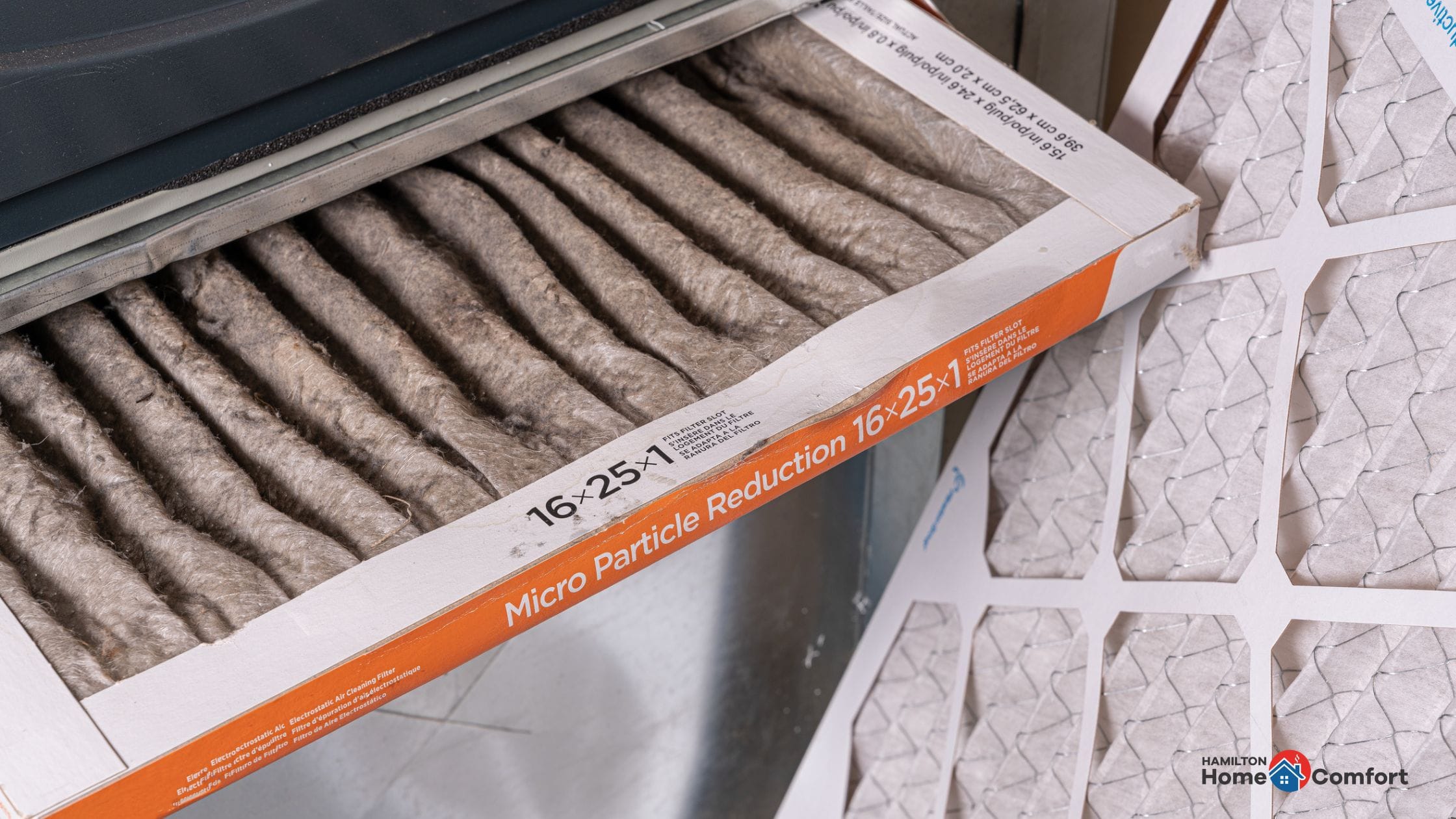
Actually take a look to see if it’s a dirty furnace filter. If it’s heavily loaded with dust and debris, there’s no benefit to leaving it in for another month just because the packaging says it can last 90 days.
Why Is Changing Your Furnace Filter So Important?
Your furnace needs airflow to operate properly.
When your heating system turns on, the blower pulls air from your home through the return ductwork, passes it through the filter, and moves it across the heat exchanger before distributing warm air through the supply ducts.
The filter helps prevent dust, pet hair, and other airborne particles from collecting inside your HVAC equipment.
But as that filter collects debris, it becomes harder for air to pass through it.
This is where problems can start.
If the filter becomes severely clogged, the furnace may not receive enough airflow to operate within its intended temperature range.
In some cases, the furnace can actually overheat.
Modern gas furnaces have a safety device called a high-temperature limit switch. If the temperature inside the furnace gets too high, the switch can shut down the burners to protect the equipment.
The blower may continue running, which can leave homeowners wondering why their furnace is blowing cool air instead of heat.
It’s one of the reasons we recommend checking your furnace filter before assuming something more serious has gone wrong.
A dirty filter can also contribute to reduced airflow, uneven temperatures, longer heating or cooling cycles, and unnecessary strain on the blower system.
Changing your filter regularly is one of the simplest things you can do to help your HVAC equipment operate properly.
Do You Need to Change Your Furnace Filter More Often if You Have Pets?
Generally, yes.
If you have dogs or cats, especially breeds that shed heavily, your furnace filter may collect debris considerably faster.
Pet hair, dander, and dust can accumulate throughout the house and eventually make their way into the return-air system.
For homeowners with multiple pets, we recommend checking the filter every month rather than automatically assuming it will last three months.
That doesn’t necessarily mean you’ll need to replace it every 30 days. It simply means you should be keeping an eye on it.
The same applies if you’ve recently completed renovations.
Drywall dust, sanding, flooring work, and other construction activities can introduce a significant amount of fine dust into the home.
We’ve seen filters become heavily loaded much faster than usual after renovation work.
If you’re having work completed in your home, it’s worth checking the filter more frequently and making sure the HVAC system is protected from construction dust.
Should You Change Your Furnace Filter in the Summer Too?
Absolutely, and this is something people commonly overlook.
Just because you’re not using your furnace to heat your home doesn’t mean the filter isn’t being used.
If you have central air conditioning connected to your furnace, the same blower and ductwork are typically used to circulate cool air throughout the house.
That means your furnace filter is still filtering air while your air conditioner is operating.
In fact, during a hot and humid Hamilton summer, your air conditioning system might be running for extended periods throughout the day.
If your filter becomes clogged, it can restrict airflow across the indoor cooling coil.
This can reduce cooling performance and, in more severe cases, contribute to the evaporator coil freezing.
A frozen coil can leave you with very little cooling, and if the underlying airflow problem isn’t corrected, it can happen again.
Our recommendation is to check your filter throughout the entire year, not just during heating season.
We often remind homeowners that furnace maintenance and air conditioner maintenance are connected. Both systems rely on the same ductwork and, in most conventional setups, the same indoor blower.
Are Expensive Furnace Filters Actually Better?
This is where things get interesting, because the most expensive filter isn’t necessarily the best choice for your furnace.
When shopping for furnace filters, you’ll probably notice something called a MERV rating.
MERV stands for Minimum Efficiency Reporting Value, and it’s a rating system used to describe how effectively a filter captures particles of different sizes.
Generally speaking, the higher the MERV rating, the better the filter is at capturing certain smaller airborne particles.
For example, a MERV 8 filter captures less fine particulate matter than a MERV 11 filter.
But here’s the part that often gets overlooked.
A filter that captures more particles isn’t automatically better for every heating system.
Higher-efficiency filters can create additional resistance to airflow, depending on their construction, size, and the amount of dust they’ve collected.
If your furnace and ductwork aren’t designed to accommodate that resistance, you could end up restricting airflow.
That’s why we don’t recommend homeowners simply purchase the highest MERV-rated filter they can find.
For many residential systems, a MERV 8 to MERV 11 filter can be a reasonable option, provided it’s compatible with the equipment. Higher-efficiency filtration may also be appropriate, but the system needs to be able to handle it.
When we’re evaluating filtration options, we consider the furnace, blower, ductwork, and filter cabinet rather than just the rating printed on the box.
Sometimes a properly sized 4-inch media filter is a better option than trying to squeeze a restrictive high-efficiency 1-inch filter into an existing setup.
The objective is to maintain good filtration without compromising the airflow your equipment needs.
How Can You Tell if Your Furnace Filter Needs Replacing?
You don’t need to be an HVAC technician to check your filter.
In most homes, the filter is located in a slot or cabinet near the furnace, usually on the return-air side of the system.
If you’re unsure where yours is located, ask your HVAC technician to show you during your next maintenance visit.
When checking the filter, look for heavy dust buildup, debris, or visible clogging across the filter material.
A filter that’s significantly darker than when it was installed may be due for replacement, although colour alone isn’t always a reliable indicator.
Some filters naturally change appearance as they collect particles, and certain types may look relatively clean even when they’ve accumulated a fair amount of dust.
So how do you know when it’s time to change the furnace filter?
If you’re noticing weak airflow from the vents, uneven heating or cooling, or your furnace shutting off unexpectedly, the filter is one of the first things worth checking.
That doesn’t mean the filter is necessarily causing the problem, but it’s an easy place to start.
One other thing worth mentioning is that filters shouldn’t be crushed or forced into place.
If you have to bend the filter to make it fit, there’s a good chance you’re using the wrong size.
A properly fitted filter should sit securely in its designated slot or cabinet without leaving large gaps around the edges.
Can a Dirty Furnace Filter Damage Your Furnace?
Yes, and this is one of the main reasons we take filter maintenance seriously.
As we mentioned earlier, a severely restricted filter can cause the furnace to overheat.
If the system repeatedly overheats, it can place additional stress on components and cause the furnace to shut down on its safety controls.
A dirty furnace filter can also make it harder for the blower to maintain proper airflow. Depending on the type of blower motor and furnace, this can affect how the system operates and contribute to unnecessary mechanical or electrical strain.
Over time, poor airflow can affect both heating and cooling performance.
Does forgetting to change your filter once mean you’ve damaged your furnace? Of course not.
But consistently operating your equipment with a badly clogged filter is an avoidable risk.
We would much rather see a homeowner spend a few dollars replacing a filter than end up needing a service call because their furnace is repeatedly overheating.
That said, if your furnace is shutting down on its high-temperature limit, don’t assume a new filter is guaranteed to solve the problem.
There may be another restriction or mechanical issue that needs to be investigated.
Can I Just Remove My Furnace Filter and Run the Furnace Without One?
We don’t recommend it. We recommend you change the furnace filter to a new one.
Homeowners occasionally ask whether removing the filter will improve airflow, particularly when their furnace is having trouble heating the house.
While removing a restrictive filter may allow more air to move through the system temporarily, it also allows dust and debris to enter the equipment.
Over time, that material can accumulate on the blower, indoor cooling coil, and other components.
A dirty cooling coil, for example, can create its own airflow restrictions and affect your air conditioner’s performance.
Your HVAC equipment is designed to operate with proper filtration in place.
If you’re finding that the furnace only seems to operate correctly when the filter is removed, that points to a problem that should be diagnosed.
It may be the wrong filter, an undersized filter opening, or a broader airflow issue.
The solution isn’t to operate without a filter. It’s to find a filtration setup that works properly with your equipment.
Which Way Does the Furnace Filter Go In?
This is another question we get fairly often, and fortunately, it’s an easy one to answer.
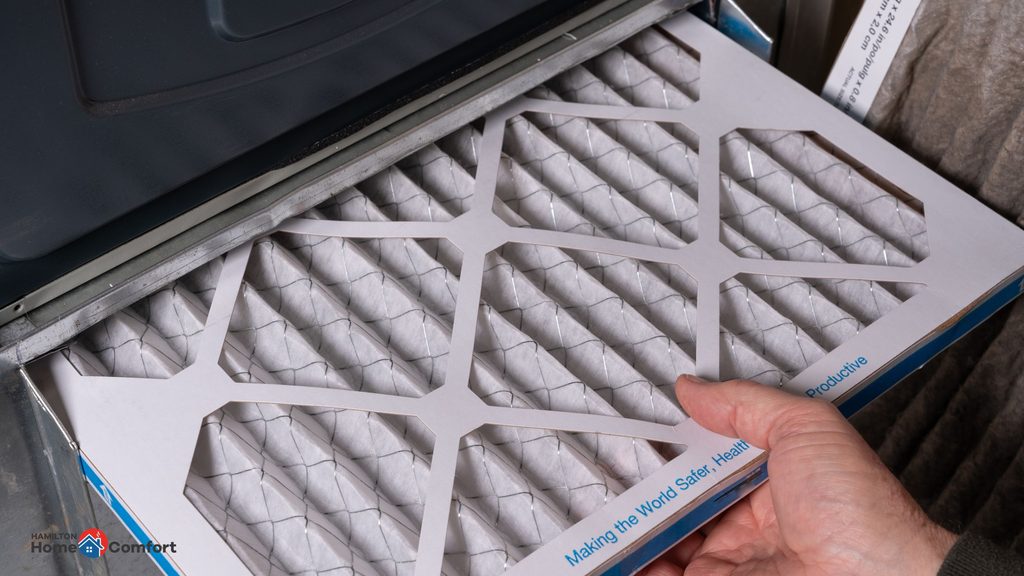
Most disposable furnace filters have an arrow printed on the frame showing the correct direction of airflow.
That arrow should point in the direction the air is moving, toward the furnace or air handler.
In a typical residential furnace setup, the air enters through the return ductwork, passes through the filter, and then moves into the furnace’s blower compartment.
Before changing your filter, turn the HVAC system off using the thermostat or the appropriate equipment control and follow the manufacturer’s instructions.
Slide the old filter out, check the airflow arrow, and install the replacement in the correct direction.
Make sure you purchase the correct dimensions. You can usually find the size printed along the edge of the existing filter.
If you’re unsure which direction the filter should face or what size you need, it’s worth confirming rather than guessing.
Is a 4-Inch Furnace Filter Better Than a 1-Inch Filter?
In many situations, a properly selected 4-inch media filter has some real advantages.
Because it has a much larger surface area of filter material, it can generally hold more dust before needing to be replaced.
That means less frequent filter changes, which is convenient for homeowners.
The additional surface area can also help provide good filtration without creating excessive resistance to airflow, depending on the specific filter and system design.
However, you can’t simply install a 4-inch filter into a furnace that was designed for a 1-inch filter.
A larger media filter usually requires a compatible filter cabinet.
At Hamilton Home Comfort, when discussing filtration upgrades, we look at whether the existing equipment and ductwork can accommodate the change.
For some homeowners, upgrading to a media filter cabinet makes sense. For others, a standard disposable filter that is changed regularly is perfectly adequate.
There isn’t a need to spend more money on filtration equipment if your existing setup is working properly and meeting your needs.
Does Changing Your Furnace Filter Help With Air Quality?
It can, but it’s important to understand what a furnace filter actually does.
The primary purpose of a furnace filter is to protect your HVAC equipment from airborne dust and debris.
However, depending on the type of filter installed, it can also help capture particles circulating through your home, including dust, pollen, and pet dander.
A higher-efficiency filter may capture smaller particles that a basic filter would allow through.
That being said, your furnace filter isn’t a complete solution to every indoor air quality concern.
It won’t necessarily address issues involving humidity, carbon monoxide, gases, or all airborne contaminants.
If indoor air quality is a concern, there are other options worth considering, including improved ventilation, properly designed filtration systems, and humidity control.
The important thing is choosing equipment that works with your existing HVAC system rather than creating additional airflow problems.
Our Recommendation for Hamilton Homeowners
If there’s one thing we’d like homeowners to take away from this article, it’s that checking your furnace filter regularly is far more important than following a rigid replacement schedule.
Change your furnace filter as part of your regular DIY furnace maintenance.
For most homeowners in Hamilton, Stoney Creek, Ancaster, Dundas, and surrounding areas, we recommend starting with a monthly inspection.
If you have a standard 1-inch disposable filter, expect to replace it approximately every one to three months.
If you have a larger media filter, it may last considerably longer, but you should still follow the manufacturer’s instructions and inspect it periodically.
Homes with pets, renovations, higher dust levels, or extended HVAC runtime may require more frequent replacement.
And remember, your furnace filter matters during the summer too.
You don’t need to overcomplicate it. Just make a habit of checking the filter and replacing it when necessary.
It’s a small maintenance task that can make a meaningful difference in how your heating and cooling system operates.
Frequently Asked Questions About Changing The Furnace Filter
Is it okay to change my furnace filter every three months?
For many homes with standard 1-inch filters, three months is a reasonable maximum interval under normal conditions. However, we recommend checking the filter monthly. If it’s heavily loaded with dust before the three-month mark, replace it sooner.
What happens if I don’t change my furnace filter for six months?
It depends on the type of filter and how much dust it has collected. A larger media filter may be designed to last six months or longer, while a standard 1-inch filter could become significantly restricted over that period. Restricted airflow can affect heating and cooling performance and, in more severe cases, contribute to equipment problems.
Should I change my furnace filter every 30 days?
Not necessarily. Some households benefit from monthly replacement, particularly those with multiple pets or significant dust accumulation. However, many standard filters can last longer. Checking the filter monthly is a better starting point than automatically replacing it every 30 days.
Can a dirty furnace filter increase my heating bill?
Yes. A clogged filter can restrict airflow and reduce system performance. Depending on the equipment, it may contribute to longer operating periods or less efficient heating and cooling. How much it affects your utility bill depends on the system and the severity of the restriction.
Do I need to turn off my furnace to change the filter?
Yes. Turn off the heating or cooling system before removing the filter and follow the equipment manufacturer’s instructions. This helps prevent the blower from pulling loose dust into the system while the filter is removed.
Can the wrong furnace filter cause problems?
Absolutely. An incorrectly sized filter may allow unfiltered air to bypass it, while a filter that creates too much resistance can restrict airflow. It’s important to use a filter with the correct dimensions and filtration characteristics for your equipment.
Do I still need furnace maintenance if I change my filter regularly?
Yes. Replacing your filter is an important part of routine homeowner maintenance, but it doesn’t replace a professional furnace inspection. Your heating system has burners, electrical components, safety controls, and other parts that require periodic inspection and servicing.
Furnace Maintenance in Hamilton and Stoney Creek
At Hamilton Home Comfort, we install, maintain, and repair residential HVAC systems, including furnaces from Lennox, Trane, and Goodman.
One thing we’ve always believed is that homeowners should understand their equipment. You shouldn’t need to be an HVAC technician to know how to look after your furnace or recognize when something isn’t operating properly.
Regular filter changes are a good starting point, but proper maintenance also means making sure the heating system is operating safely, efficiently, and within the manufacturer’s specifications.
Whether you’re having trouble with airflow, your furnace isn’t heating properly, or you’re looking to arrange routine furnace maintenance, our team can help identify the issue and explain the available options. Contact Hamilton Home Comfort today.
Follow Hamilton Home Comfort on Instagram and Facebook for the latest home comfort tips, company news and HVAC insights.