

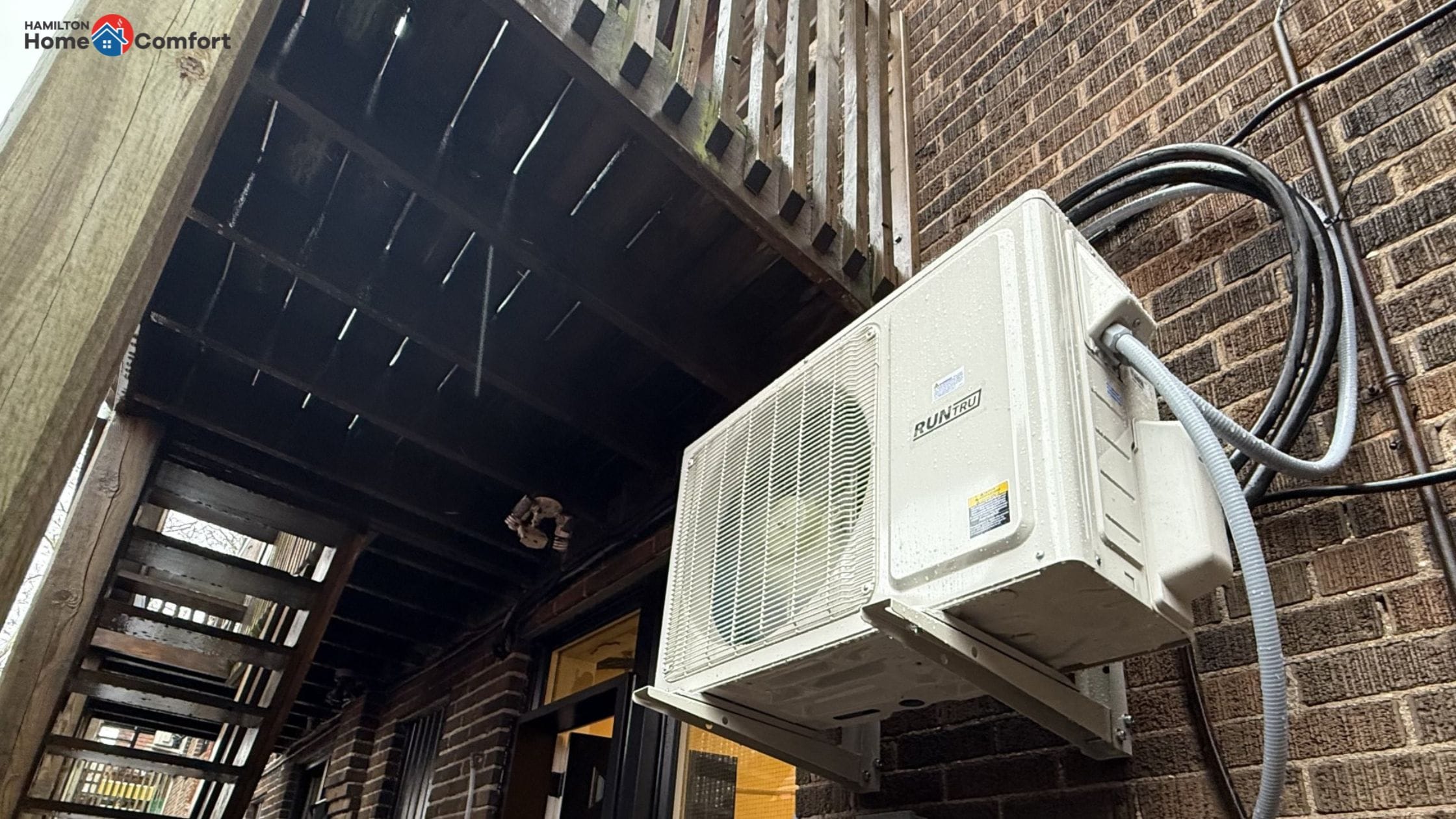
Can a heat pump replace a furnace? Yes, a properly designed heat pump system can replace a gas furnace, but that does not mean every homeowner should remove a working furnace. In Southern Ontario, keeping the furnace and adding a compatible heat pump is often worth considering, particularly when an aging air conditioner needs replacement.
We hear this question from homeowners looking at heat pump installation in Hamilton and Stoney Creek: “Will I still need my furnace in January?” The answer depends on the home’s heat loss, the heat pump’s actual low-temperature performance, and whether the system includes backup heat.
Here is how we explain the options when it comes to a choice between a heat pump and furnace, and hybrid heat pump and furnace configurations.
Can a Heat Pump Replace a Furnace?
A heat pump heats and cools a home. In summer, it transfers indoor heat outdoors, much like an air conditioner. In winter, it moves heat from outdoor air indoors. Even cold outdoor air contains heat energy, but a heat pump’s output and efficiency vary with temperature.
There are three sensible setups:
All-electric heat pump: a cold-climate heat pump provides primary heating and cooling, with supplemental electric heat or another appropriately designed backup where needed.
Hybrid heat pump or dual-fuel: an electric heat pump works with a compatible gas furnace. Controls switch between the two based on the system design.
Conventional: a gas furnace handles heating and a separate air conditioner handles cooling.
The important question is not whether a heat pump can run at -20°C. It is whether the selected equipment can meet your home’s heating load at the temperatures it is expected to face.
Heat Pump vs. Gas Furnace: Side-by-Side Comparison
| Comparison | Gas furnace | Heat pump |
| What it does | Heating only | Heating and cooling |
| Energy used | Natural gas plus electricity | Electricity |
| Method | Burns fuel to create heat | Moves heat from one place to another |
| Efficiency measure | AFUE; high-efficiency models commonly 95%+ | COP/HSPF2; varies by outdoor conditions |
| Very cold weather | Strong output if properly sized | Output and efficiency are model-specific; backup may be needed |
| Cooling | Requires a separate AC | Built in |
| Upfront work | Often simpler when replacing like-for-like | May require electrical, duct, controls or backup changes |
| Operating cost | Depends on gas pricing and furnace efficiency | Depends on electricity pricing, COP and weather |
| Best fit | Straightforward gas-heating replacement | Year-round electric heating/cooling or a hybrid upgrade |
Bottom line: a furnace is excellent at providing heat in very cold weather. A heat pump offers heating and air conditioning in one piece of equipment and can use much less purchased energy to deliver a given amount of heat. Neither is automatically cheapest to operate in every Ontario home.
Will a Heat Pump Work Through a Hamilton Winter?
Yes, properly selected cold-climate heat pump models can heat Ontario homes through winter. Some are designed to operate well below -20°C, but “operates at” is not the same thing as “delivers full rated heating capacity at.” Different products perform differently as the temperature falls.
Before recommending an all-electric heat pump installation, we would look at:
- The home’s calculated heat loss, not just its square footage
- The heat pump’s published heating capacity at local winter design temperatures
- Insulation, air leakage and window condition
- Duct sizing and airflow, particularly in older forced-air homes
- Electrical capacity and any supplementary-heating requirements
- The homeowner’s comfort preferences and likely operating costs
An older, draftier home may need a different solution than a newer home with similar floor area. That is why replacing equipment based only on the size of the old furnace can lead to problems.
Why Consider a Hybrid Heat Pump and Furnace?
A hybrid heat pump and furnace system keeps a gas furnace and adds a compatible heat pump in place of a conventional central air conditioner. During cooling season, the heat pump provides air conditioning. In milder heating weather, it can heat the house electrically. When outdoor temperatures fall below a selected changeover point, the furnace takes over.
For someone whose furnace is still in good condition but whose AC is due for replacement, this can be a practical option. You get heat-pump heating for part of the year without throwing away a functioning gas furnace. This is why a hybrid heat pump and furnace system works for some.
The changeover temperature is not one universal number. It should reflect the heat pump’s capacity, local energy costs, equipment compatibility and the controls installed. It is also worth confirming whether the furnace, indoor coil, thermostat and outdoor unit are approved to work together.
Will A Heat Pump Lower Your Heating Bills?
It might, but a lower bill is not guaranteed. Heat pumps can supply two or more units of heating energy for each unit of electricity consumed under many operating conditions. That makes them efficient, not automatically less expensive than natural gas.
To compare operating costs fairly, look at:
- Your actual gas rate, including variable delivery charges.
- Your electricity rate and pricing plan.
- The heat pump’s efficiency at the outdoor temperatures where it will run.
- The home’s annual heating demand.
- Whether you retain a gas account and its fixed charges.
- The system’s switch-over settings if you choose hybrid heating.
We would be cautious about anyone promising a specific percentage of savings without reviewing the equipment and utility assumptions. The best answer comes from a realistic estimate, not a blanket claim.
When Should You Keep The Furnace, And When Should You Replace It?
- Your furnace is fairly new, but your AC is old: ask about a compatible heat pump paired with your existing furnace.
- Both furnace and AC are near the end of their useful lives: compare a new furnace-plus-heat-pump package with a properly sized all-electric setup.
- You want to eliminate natural gas: investigate a cold-climate heat pump, backup heat, ductwork and electrical requirements together.
- You want the simplest replacement and prefer gas heat: a high-efficiency furnace with a conventional air conditioner remains a reasonable choice.
A good contractor should be able to explain why a particular arrangement suits your home, even when the recommendation is to keep equipment you already own.
What are the Real Pros and Cons Of Heat Pumps?
Advantages of heat pumps:
- One system provides heating and cooling.
- They can be very energy efficient in suitable conditions.
- A hybrid heat pump and furnace setup can reduce annual natural gas use.
- Variable-capacity models may offer steady temperature control and quieter operation.
- Electric heating at the home has no on-site gas combustion.
Things to account for:
- The installed cost and possible electrical or ductwork modifications.
- Model-specific heating output at low temperatures.
- The need for backup heat in some all-electric designs.
- Correct equipment matching and control setup in hybrid installations.
- Energy savings that depend on local rates and how the system operates.
Which Heat Pump Brands Does Hamilton Home Comfort Carry?
At Hamilton Home Comfort, we carry and recommend heat pump equipment from Trane, Goodman and Lennox. Each manufacturer offers different equipment families and price points. We focus on matching the actual model to the home rather than telling everyone that one brand is the answer.
Trane offers heating and cooling equipment with options for homeowners interested in comfort and variable-speed performance. Goodman has solutions across different budgets, including equipment suitable for approved dual-fuel pairings. Lennox also offers a range of efficiency levels and variable-capacity options.
Features, cold-weather ratings, warranties and compatibility vary by model. We would verify those details for the exact unit being quoted instead of applying one performance claim to every product carrying the same brand.
What Kind of Heat Pump System Would You Recommend For A Southern Ontario Home?
For a homeowner in Hamilton, Stoney Creek, Ancaster or Burlington who has a working furnace and needs a new air conditioner, we think a hybrid heat pump deserves a serious look. For someone replacing an entire aging system, we would compare both hybrid and all-electric options against the home’s heating load and budget.
The right choice is not necessarily to remove every gas appliance, nor is it to rule out heat pumps because Ontario gets cold. It is to select equipment that can meet the heating demand, install it properly and explain the cost trade-offs clearly.
Heat Pump Installation In Hamilton And Surrounding Areas
Hamilton Home Comfort installs heating and cooling equipment for homeowners throughout Hamilton, Stoney Creek, Ancaster, Dundas, Binbrook, Burlington, Grimsby and the Niagara region. We can assess an existing furnace, discuss whether a hybrid heat pump and furnace arrangement is compatible, and compare it with a full heat pump replacement.
Quality Craftsmanship. Quality Service. No Shortcuts.
Frequently Asked Questions
Can I keep my existing furnace and add a heat pump?
Often, yes, if the furnace, indoor components and controls are compatible. The installer should confirm the approved equipment pairing and airflow requirements.
Do heat pumps work at -20°C?
Many cold-climate models do. Their actual capacity at -20°C must be checked against the house’s heating load; some systems need supplemental heat.
Does a heat pump replace my air conditioner?
Yes. A central reversible heat pump provides air conditioning as well as heating.
Is a heat pump cheaper than a gas furnace in Ontario?
Not always. The answer depends on electricity and gas pricing, outdoor temperatures, equipment efficiency and how the system is controlled.
Can I use my existing ductwork?
Often, but duct sizing and airflow need to be checked. Existing ducts are not automatically suitable for every replacement.
Can A Heat Pump Replace A Furnace? Find Out More From Hamilton Home Comfort
As every home is different, and your needs are specific, it’s always best to get a consultation with Hamilton Home Comfort for a heat pump vs. furnace discussion. You want to know whether a heat pump can replace a furnace in your home. The solution may be something like a hybrid heat pump and furnace.
Contact us at Hamilton Home Comfort. We provide HVAC – heating and cooling services in Hamilton, Burlington, Oakville, Brantford, Grimsby and surrounding areas.
Follow Hamilton Home Comfort on Instagram and Facebook for the latest home comfort tips, company news and HVAC insights.
Quality Craftsmanship. Quality Service. No Shortcuts.